Post 14- On the way from Baja to the mainland- Mexico

January 30, 2026
No more hostages in Gaza

The Crossing
We arrived at the port on Monday at two in the afternoon, exactly as instructed.
We were sent to be weighed. We met a heavyset Mexican man who showed us the rate in Spanish, with only a few English words, and it was higher than what the clerk had shown us a few days earlier. However, if we paid him 2,000 pesos in cash, he said he would make sure the price came out lower. We didn’t have that amount in cash, and the whole situation raised questions anyway, so we politely declined his offer.
And indeed, after a few minutes of weighing (or something that looked like weighing), the price of our ticket together with the Duba shot up dramatically, to an unexpected $1,000. To this day, we don’t know—and probably never will—whether we could have gotten it cheaper if we had somehow cooperated with him. After that, I went to the ferry company office to settle the payment. There, we also received vouchers for dinner and breakfast.
Entering the port, waiting in line to be weighed
The next step was to approach the ferry and figure out how and when we would board.
The entire process was accompanied by speculation from everyone—except the truck drivers, who clearly did this regularly. We weren’t the only tourists with campers, and everyone was trying to understand where the line was and which line was which. Eventually, they arranged us in a parking area facing the ferry, and another three hours passed while we waited to board. While watching the many types of trucks being loaded, we realized the ferry had three levels: one deep in the belly, one above it that was fairly enclosed, and one on top, open to the outside. We started praying we would be sent to the top, and we heard stories about campers who had been sent down below in shame. We watched the truck drivers load their vehicles with remarkable virtuosity—some reversing, others executing extremely complex maneuvers —all with impressive skill. But after an hour and a half of watching, even that was fully exhausted. We waited, chatting with other travelers who were waiting as well. I was actually glad we were kept for last, because that meant we would be among the first to disembark—and that felt preferable.
Eventually, we were sent up to the top deck (a sigh of relief) and parked tightly between trucks on three sides. Luckily, private cars were placed on the fourth side. All the vehicles—cars, trucks, campers—were packed extremely close together, like sardines.
Our ferry from afar and up close, port drama—a truck overturned into the water
(We had no idea what happened, but it gave us something to watch while waiting to depart.) Below: the upper deck packed with trucks, and us among them.
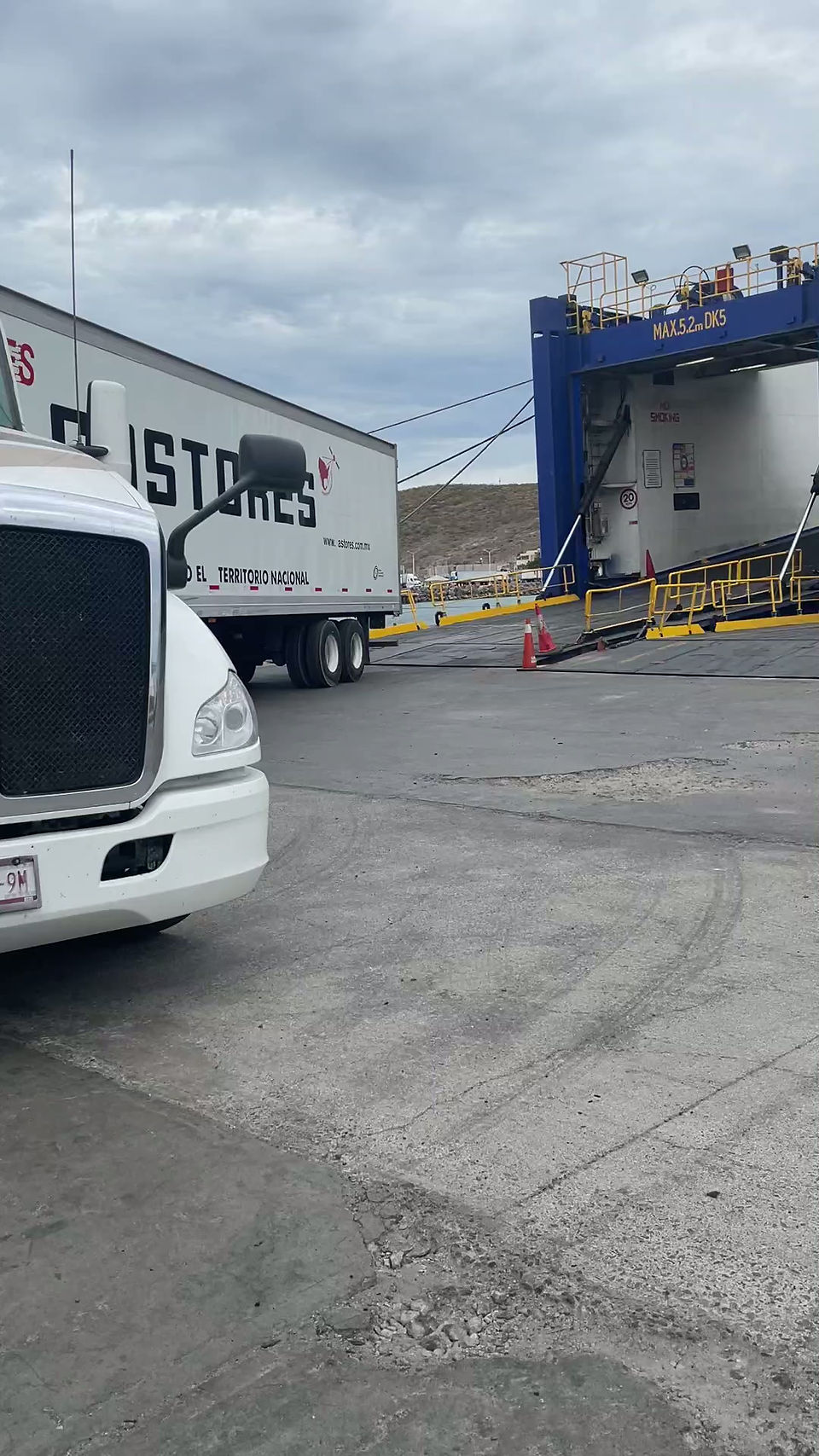
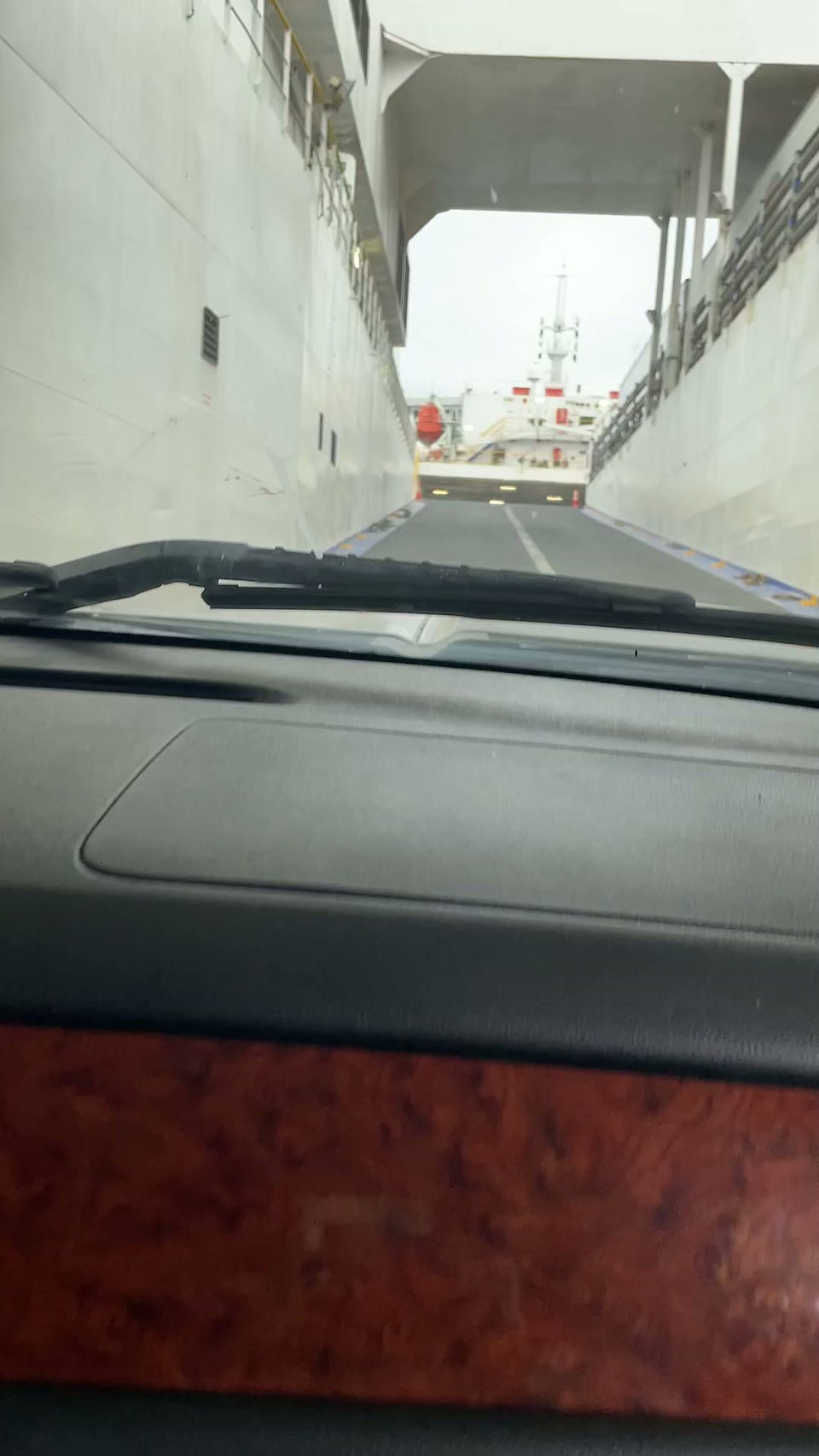
trucks on the way and then us
At 6:15 in the evening, we finally set off, slowly, heavily, and were rewarded with a spectacular sunset from the upper decks of the ferry.
Despite my worries about the crossing (crowding, claustrophobia, the motion of the waves, nausea, and more), the journey turned out to be surprisingly pleasant at times. We ate dinner and breakfast with the truck drivers, and that’s how we learned how they roll a tortilla into a cone to use as a knife, since no cutlery was provided anywhere, and how they bite into it as they go.
The ferry gradually picked up speed, the rocking wasn’t too intense, and the constant hum of the engines filled the air. We found our way back to the Duba (Bear) in the darkness, stepped into our little home for a quick shower, and slept a somewhat swaying night. In the morning, we woke to sunrise. The sun rose, the sky was cloudy, and there had been some rain overnight. Standing on the upper deck and watching the water surround us from all sides was a very special experience. There was something hypnotic about being inside the movement, the constant engine noise, and the endless water.
sunset from the ferry
At some point, land began to appear through the fog, and every now and then, in the distance, I saw a whale breach for air and disappear back into the depths.
As we approached the port, inflatable boats pushed the ferry and helped guide it toward the dock.
After about an hour, we found ourselves back on solid ground, on Mexican soil, setting out on a new road.
First moments in Mexico
(No photos - we were 100% focused on surviving the events.)
Before the crossing, we had decided to find a place to sleep in a parking area relatively close to the city we were sailing to - Mazatlán - and that’s where we headed.
But Google Maps had planned something different for us. For some reason, it led us into a very narrow street lined with trees. At first, a branch hit the awning covering the slide-out, and it broke completely. Such a disappointment.
In the second stage, as we tried to get out of the street, which was narrowing, we ran into more low-hanging branches and cars blocking the way. Five Mexicans immediately jumped in to help us. One moved a car, another moved a car, and the other three gave directions and instructions, helping us escape the maze - confused and disappointed by the damage.
We wanted to get out of the city as quickly as possible to avoid further trouble, but we needed cash. Here, you never know when you’ll need it, and not everywhere accepts credit cards. We looked for a bank and once again found ourselves on a very narrow street. There was an ATM with a long, winding line. Okay, I went to stand in line, and Guy did what we had decided together we would never do, no matter what: he reversed to get out of the maze we had entered again. Our bike rack hit a car parked on the street, leaving a scratch on its bumper.
A nice young man came out - it was his car. In fact, the entire neighborhood came out. There was no anger, no blame, no shouting - not for a moment. Everyone was pleasant. They invited us into their yard. He made a few phone calls during which I heard him say we were Americans (because of our license plate), and then he came back with $200 to pay for the damage. We didn’t argue. We took responsibility.
The ATM I had been standing in line for refused to dispense cash, so the man took us to a supermarket, where we withdrew cash and paid him.
Does this sound familiar?
I began to recognize a developing pattern—and I didn’t want to cooperate with it. We were not going to pay $200 every time we crossed a border. That was it.
Exhausted, we arrived at a campground outside the city. We were given a spot near the bathrooms, but with water and electricity hookups, and we decided to stay for two nights to ground ourselves a bit before continuing. The campground was right by the sea, almost completely full, mostly with enormous RVs—bus-like vehicles inhabited by Canadian retirees spending the cold winter months on the Mexican coast. By the next day, we had already figured out where everyone gathered for the local Canadian parliament. In general, we met many American and Canadian retirees who lived here in Mexico for at least part of the year.
After an exhausting day, with the “Canadian neighborhood” behind us
There’s nothing like a plate of papaya and pineapple to soften any disappointment.
The Neighborhood
Morning and evening walks along the beach - how wonderful it was that sunset and sunrise were just a touch away.
We got on our bikes and rode around the neighborhood. We discovered a café owned by a Swiss woman, which she called Casa Avoda. When I asked her about the name, she said it came from Hebrew, meaning cultivation and nurturing the relationship between humans and the land, livelihood, vocation, profession, career, and devotion. It was beautiful. We drank coffee and matcha tea and bought sourdough bread - a rare commodity in our parts. As we wandered, we discovered the food the locals ate, and it was the tastiest, most comforting, and cheapest of all.
Coffee, matcha tea, lunch, and sunset
The Roads
We didn’t stay long in the crowded campground. The next day, we hit the road.
We began learning about the roads. From the information we gathered, we learned that toll roads were preferable, although even they weren’t always the sharpest tool in the pencil case.
We bought a reloadable card that attaches to the windshield, making it faster and easier to pass through toll booths. We reloaded the card at Oxxo stores - convenience stores similar to those attached to gas stations, except they were everywhere, even without a gas station nearby. That’s also where we exchanged empty water bottles for full ones.
Topes
I had already written about them and our first encounter with them in Baja, but here in mainland Mexico, they only became more sophisticated - appearing suddenly, without warning, in all kinds of shapes, sizes, and surprises - and they were quite brutal. We learned that as soon as you reached a populated area, there would be some at the entrance to town and some at the exit, and anyone who paid could even get them installed outside their shop to increase foot traffic.
We learned to spot them in advance and slow down to almost a full stop.
We would probably write more about the roads later - we had only just begun to learn them.
Hard to see even in photos
In the middle: an example of a very common road in every town and village. Driving and riding on these was a challenge for the Duba (bear), and for our bones.
Santa Cruz De la Miramar
We had planned to reach Mexico’s largest lake, Lake Chapala, and, to avoid driving too many hours in a day, we split the journey into two segments. Our first stop was this small town. Just before it, there was a hotel that also hosted campers in its beautiful yard. To reach the hotel, we drove along winding roads and eventually reached a stone road - each stone a different size - making the drive extremely slow. We were the only ones parked in the huge yard with a well-kept green lawn. The hotel was very old but well maintained, built right on the sea, though there wasn’t really a beach in that area. One of the housekeepers told us there was also a crocodile roaming around and that we should be careful.
After parking, I opened the camper door, and my heart sank. All the drawers (three small ones) were on the floor, and almost all of our glasses were shattered. The slow driving hadn’t helped us. Even though the drawers were built with internal locking mechanisms designed to prevent them from opening while driving, those mechanisms were made for driving in the United States—not in Mexico. We had the opportunity to buy colorful Mexican mugs.
The result of driving on the road above + Topes
And our solution to prevent such disasters in the future

We bought new ceramic mugs at the neighborhood grocery store- 2$ each
We stayed there for three nights. The weather warmed up, and with it came the mosquitoes. Sitting outside was still a great pleasure.
We rode our bikes into town, did laundry, ate excellent fish, bought hot tortillas straight from the oven, and bought banana cake sold right on the street outside the house.
Tequila
After three nights, we packed up and drove east for a few hours, and mountainous Mexico opened up before us - mountains and hills, winding roads, valleys, fields, and orchards. Green, agricultural, breathtakingly beautiful land. We arrived at a small, peaceful town named after the famous cocktail, located in the heart of Jalisco state, surrounded by hills and endless fields of blue agave from which the well-known tequila is produced. On the iOverlander app, I found us a farm to stay at. The farm’s owner, José, turned out to be a fascinating man, fluent in English. He told us he was a fourth-generation tequila grower and that the farm had been in operation for 105 years. It was a very small farm compared to the scale of production in Jalisco, one of the states authorized to grow and produce tequila.
Nearby stood a dormant volcano that had enriched the soil for many years. Life here revolved around land, agriculture, and tradition passed down from generation to generation. Tequila was born here as part of the local culture and identity.
José gave us a tour of his agave fields. From there, we moved on to the distillery, where we learned about the entire process - including tastings that left our heads spinning.

The 20-year-old mare, part of the family, accompanied us on the tour. She was extremely friendly and enjoyed our petting.
It turned out that the farm was ecological, and the tequila was completely organic, without pesticides. The agave grew in the fields for nine years until reaching maturity, at which point it was harvested and taken to the distillery. To control weeds, horses and cows roamed the fields, grazing them and leaving ample open space for the agave plants. In addition, chamomile plants grew alongside the agave, and their flavor was detectable in the drink.
Agave harvesters (jimadores) cut away the leaves to expose the core—the piña—which looked like a giant pineapple. Inside the distillery, there was a massive oven into which the cut piñas were packed and cooked.
The cooking converted the agave’s starches into fermentable sugars. After that, the cooked agave was crushed and transferred to large vats for fermentation with the addition of natural yeasts. In the next stage, the liquid was distilled two to three times, resulting in the clear, strong tequila. From there, it could undergo an aging process, creating four different types of tequila:
Blanco – unaged
Reposado – 2–12 months
Añejo – 1–3 years
Extra Añejo – over 3 years
We were lucky enough to taste a 10-year-old tequila.
The aging took place in wooden barrels (usually oak), specially imported from France.

You could see the fruit - looking like a pineapple on steroids. After cutting, it went into the oven to cook, and below were smiles after five glasses of tequila. In the photo was an American couple we met at the farm, the first people we encountered on the road who, like us, were traveling the Pan-American Highway. That evening, we sat together with cups of tea and exchanged stories.
So if you drink tequila, make sure the bottle says 100% and not Mixto, which means it’s blended with other sugars and substances.
We stayed the night at the farm, with chickens, horses, and cows, sunset and sunrise, and vast blue skies that reminded me that everything is possible.
We are gradually falling under the spell of the colors, history, people, and culture
And to conclude, of course, the words of Guy the poet:
Relativity
Giant trucks were swallowed into the belly of the ferry
They responded gladly to the signals of the guide
Gathered on the deck in rows and columns
And suddenly, everything felt like a children’s game
A person quenched his thirst with cups of drink
Yet his being was not filled
He replaced an empty cup with a full one.
I stopped counting
After a single shot
And the hardships of the day stood like a wall before you
The load was heavy
The legs faltered
And a bleak wind grayed your face
Then the eyes opened to look around
And the soul, even when weary, knew
That it was only the point of view that mattered
Only the point of view that mattered

Just before finishing, we wanted to thank you from the bottom of our hearts for all the gifts we received from you along the way—whether in the form of a wonderful playlist that made our drives more pleasant, sent by the amazing Oren, or poems, or helpful notes drawing our attention to Silvy’s tires (they were being checked). It truly warmed our hearts to know you were with us. As the months passed, the importance of family, friends, and community became increasingly clear as we traveled on such foreign and distant roads.
Until next time,
With love,
Guy, Efrat, and the Duba (bear)


Comments