Post 19- Winds of War

March 5, 2026

Agua Azul
I sit down to write this post with a heavy heart. We are far away, on the other side of the world, and back home, in Israel, there is war again. The news reaches us through our screens, once again the same familiar story, and the worry crosses oceans.
At the same time, life here continues. People wake up in the morning, drink coffee, go to work, and laugh in the street. There are no sirens, no running to shelters. Two worlds exist in parallel, and we are somewhere in between. The body is here, the heart is there. We try to hold both at once, to be present in our journey and, at the same time, remain connected, alert, and quietly praying for peace and calm for everyone.

A small word about time. My posts are always written with about a week’s delay. I don’t write from within the moment itself, because I need the experiences to settle a little, for the dust to fall, for the heart to process, for the meaning to become clearer. Only then do I sit down to write. This is how it has evolved over the past months, and it’s a rhythm that works well for us as we travel both outward and inward.
So this post also describes the week that preceded the one we are currently in. It was written in days that were quieter, before the war that has now erupted back home. By the time you read this, reality has already changed.

The Ceiba tree is considered sacred in Maya culture. Its roots reach into the underworld, Xibalba; the trunk represents the world we live in; and its high branches reach toward the heavens and the gods. The Maya believed that souls passed through this tree between worlds, and they imagined its four main branches as the four directions of the sky.
In the previous post, we finished working on the Duba, packed up, and set out on the road again after a pleasant and grounding week in San Cristóbal.
I had read about a special pyramid site called Toniná and decided it would be our first stop along the way. We arrived after four hours of driving through mountainous regions on winding roads. During the first two hours of the drive, smoke began coming from the wheel area, accompanied by a burnt smell. We were alarmed and pulled over to the side of the road.
I immediately opened a small “war room” with Chatty and with our star navigation app, iOverlander, searching for nearby mechanics. Nothing. We were in a nearly uninhabited area with no garages. But the more precisely we described the situation to Chatty, the more reassuring the information became. She told us that this can sometimes happen after brake replacements and suggested driving a little further to see what happens. And indeed, we continued cautiously, and everything cleared up as if nothing had happened. What a relief.
We arrived at the pyramid site parking lot, and someone approached us to explain that the site was closed for renovations. Of course, that important detail had not been updated on Google Maps. Disappointed, we decided to continue to the next stop, where we had planned to spend the night.
After four hours of driving, in a brief moment of inattention, we set the navigation and started driving without double-checking the route. Maybe I should open a weekly section called “The Adventures of Google Maps.” In any case, we left the archaeological site and turned left as the navigation instructed.
After a few minutes, we entered a dirt road. It was fairly reasonable at first, so we kept driving. Gradually, the road became winding, mountainous, narrow, and very rough. We had already been driving for half an hour and still had another hour and fifteen minutes to reach our destination. We decided not to turn back.
And so we entered a true mountain adventure in Chiapas (the state we were in). We found ourselves on roads that were barely roads at all, passing through small, remote villages where hardly any cars seemed to pass. Everyone came out to look at us—the strange people driving through with our enormous White Bear.
The region is extremely mountainous, with steep climbs and descents. The road was incredibly narrow. At times, we drove straight through streams crossing the path, and I tried not to look to the sides because my heart was already racing. The mountain slopes were steep, the road winding and broken. We drove at around 15 km/h, progressing slowly.
Eventually, the road began to widen and turned into Highway 199—the road we were supposed to be on in the first place. We merged onto it with great relief, but also with the feeling that we had just passed through hidden, rural, and very special back regions of Mexico.
I didn’t photograph the difficult moments—it was a bit too intense—but here’s a small collection of what we did see along the way. It was fascinating.
With our last remaining energy we arrived at -
Agua Azul
We parked the Bear in a place where we could spend the night, and then an astonishing beauty revealed itself before us.
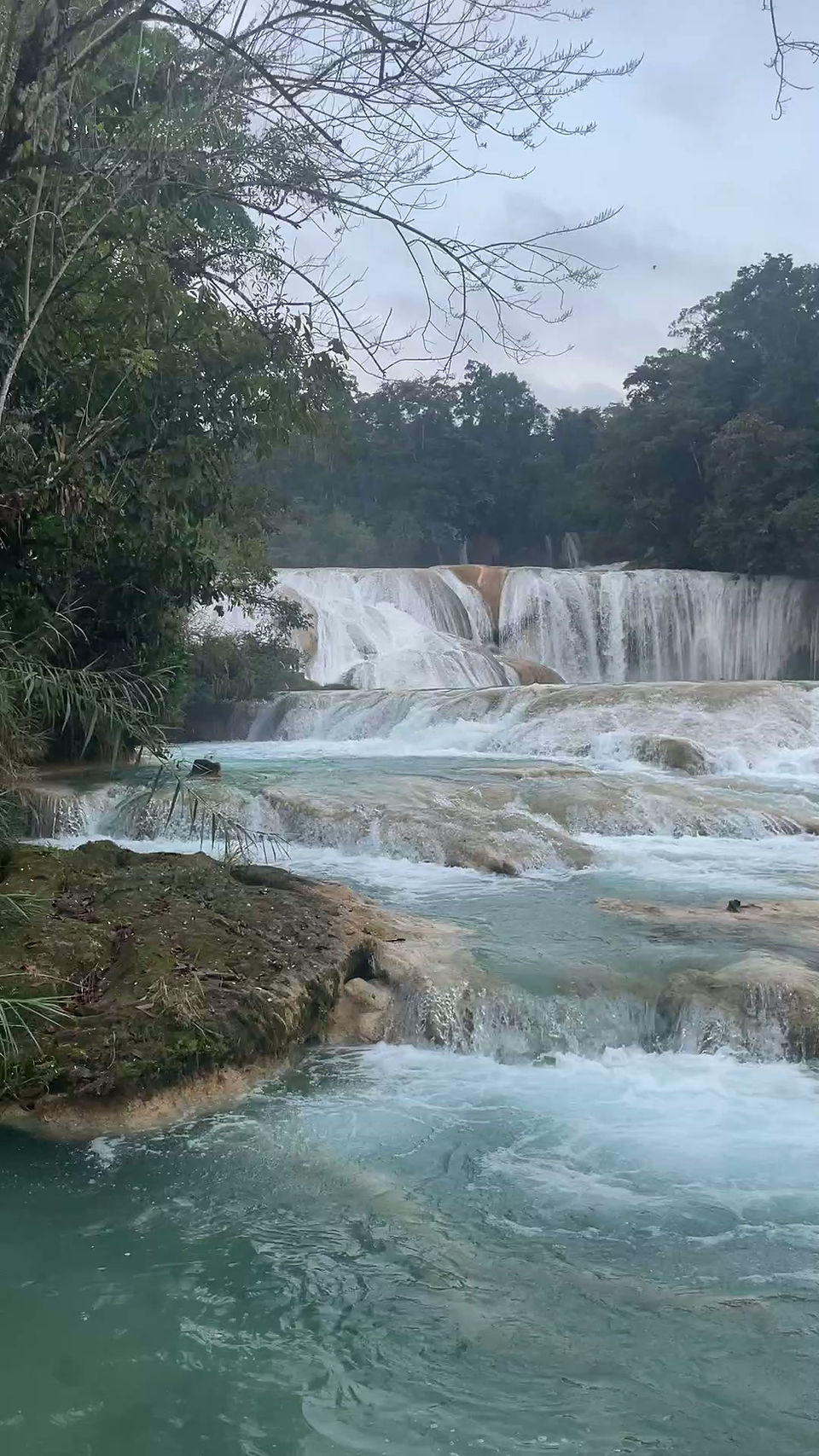
We stood in front of a sequence of waterfalls and terraced pools in the heart of the Chiapas jungle. What makes the place unique is the intense turquoise color of the water, created by a high concentration of minerals (mainly calcium) and the fast flow over limestone rocks that form natural steps and clear swimming pools.
The waterfalls belong to the Tulijá River system, and the area is partly inhabited and managed by local communities. It’s a popular natural site, yet it still preserves a sense of wildness—a beautiful combination of flowing water amid the deep green jungle.
We struggled to fully take in the beauty amid our exhaustion, but the warm weather helped us switch to summer mode, and we slipped into the incredible water for a short, refreshing swim.
From every angle the flow and colors were mesmerizing
I couldn't stop taking pictures
On the sign in the middle it said, roughly translated:“Plants are like friends. They need attention and constant care in order to grow and flourish.” So beautiful.

Finally, richer vegetation—and flowers too
The next day, we continued on a relatively short driving day.
Our first stop was the archaeological site of
Palenque
It’s a well-organized site—parking, shuttles, and three different entrance tickets you have to pay for. But once you arrive at the site itself, it’s breathtaking. In the middle of the jungle, among trees and flowers, stand the remains of the Maya empire.
We received a bracelet for each ticket
This is one of the most impressive and important Maya sites in Mexico. It was a city-state that flourished mainly during the Classic period (roughly 600–800 CE). Its original name was Lakam-Ha (“Great Water”), and it became famous for its refined architecture, rich reliefs, and detailed hieroglyphic inscriptions that helped researchers reconstruct Maya political history.
Its most famous ruler was King K’inich Janaab’ Pakal (Pakal the Great), whose tomb was discovered in 1952 inside the Temple of the Inscriptions—one of the most important archaeological discoveries in Maya civilization.
The site includes major ceremonial complexes such as the Palace of Palenque, the Temple of the Inscriptions, and the Group of the Cross temples. It beautifully demonstrates the Maya's advanced astronomical, engineering, and artistic knowledge.
The city was gradually abandoned in the 9th century, likely as part of the broader collapse of the Classic Maya cities, and today it lies within dense jungle, giving it a powerful feeling of connection with the surrounding natural world.
We wander, climb, touch the stones, sit quietly, and breathe the ancient air that still flows through the place.
While climbing one of the structures, we suddenly hear a couple speaking Hebrew—a rare sight—and happily stop to exchange travel experiences from Mexico.
On our way out we begin hearing on the news that the local police had killed a major cartel leader, and chaos had erupted in the region. Some areas were burning, violence was spreading, road blockades and fires were reported, and the police asked residents in certain areas not to leave their homes.
We checked carefully. Palenque, where we were at the time, in southern Chiapas, is not considered a central cartel area, and life there seemed to continue relatively calmly.
Still, we moved toward a place where we could spend the night—a hotel parking lot. When we arrived, they guided us to park in the hotel's lot. That was a first for us—sleeping in a hotel parking lot. Cars and buses were constantly coming and going, making it hard to create a sense of privacy.
But on the other hand, the place was closed, guarded, and secure, which gave us peace of mind for the night.
We are leaving early in the morning with pouring rain
The next morning, we decided to get up early and move further east, where, according to the news, things were completely calm. It was a five-hour drive.
We packed up and set off, and the road went smoothly. The scenery gradually changed from dense jungle to more open landscapes—still very green, but no longer mountainous. We left behind the winding roads, steep climbs, and descents.
At some point, we met the sea again—this time the Caribbean, part of the Atlantic Ocean. A sign that we had reached the eastern side of Mexico, something new in our journey.

This, too, is a form of community
We arrived at a campground outside the city of Campeche, belonging to a family who lives there. They also have guest rooms, a small water park, guided tours, horses, and probably other things we didn’t even notice.
They welcomed us warmly and immediately connected us to electricity and water. A few minutes after we arrived, two more campers pulled in with French families whom we had met earlier at another campground. Each family had two children. They took out tables and chairs, and suddenly we were a small community in the middle of the road.
In the mornings, the children study independently using workbooks, while the parents help them. In the evening, they invite us to sit with them, drink wine, beer, and mezcal, and share stories from the road.
One family had sold their house, bought a truck, and built the entire interior themselves according to a design they created. They gave us a tour of their “home.” It was incredible: two teenage sons, each with their own space; a kitchen with a dishwasher; a seating area; a shower; and a toilet—all beautifully finished. Amazing that everything fits inside a truck.
The other family lives in a very old caravan, which looked just as charming and cozy.
The truck-traveling family told us how they enter cities: she drives, and he sits on the roof to move branches and stray power lines out of the way. At that moment, we realized that our situation was actually quite good.
The next day, we separated Silvy and drove to another nearby archaeological site called Edzná.
Edzná is a large and impressive Maya site in the state of Campeche, yet relatively quiet and far less visited than other sites in the Yucatán.
The city was founded around 400 BCE, and at its peak, it was an important political and agricultural center with thousands of residents.
One of the most fascinating features of the city is its sophisticated water management system. The Maya built canals, reservoirs, and pools that collected rainwater, allowing agriculture to flourish in an area without permanent rivers.
For the Maya, water was not only a source of life but also a gateway to the underworld—Xibalba.
In Maya cosmology, the underworld was a spiritual realm beneath the earth, a place inhabited by gods and natural forces, and the destination of souls after death.
At the heart of the site lies the Great Plaza, surrounded by temples and administrative structures. Above them all rises the most impressive building in the city—the Temple of the Five Stories, a unique pyramid-palace about 30 meters high, from which one can see the open landscape of jungle and fields surrounding the site.
Walking among the broad structures and green lawns, it is easy to imagine the city as it once was—work, agriculture, ceremonies, and daily life unfolding in the green heart of the Yucatán.
We are repeatedly surprised by the impact these archaeological sites have on us. We are captivated by the history, the stories, the atmosphere, the stones, and the opportunity to touch a culture so different and on such a vast scale.
At the same time, we are also horrified by certain practices—such as the human sacrifices offered to their gods.
We said a warm goodbye to the couple who hosted us in their yard, and he happily placed the sticker we gave him on his car.
We are now in the Yucatán.
The state of Yucatán is different in many ways from other parts of Mexico. The region is relatively flat and built mostly of limestone, so there are almost no mountains or visible rivers. Rainwater quickly seeps into the ground, creating underground water systems and caves known as cenotes.
Because of this geological structure, the landscape is open and wide, covered with lower vegetation and often appearing less dense than the jungles of other regions.
The roads in Yucatán are also considered significantly better than in many other parts of Mexico. This is due to a combination of more stable regional governance, greater investment in tourism infrastructure (around places like Mérida and Chichén Itzá), and the flat terrain that makes road construction and maintenance easier.
We truly enjoy driving on these wide, smooth roads, free of potholes. Even the Bear seems to breathe a sigh of relief.
We decide to skip the major tourist strongholds in the region—such as Cancún and the famous pyramid site of Chichén Itzá—and instead look for quieter, more hidden, and more affordable places.
We chose the city of Mérida and booked an Airbnb for the weekend to rest a bit from the road. We chose an apartment on the edge of the city so we could park the Bear comfortably nearby.
The apartment was spacious, everything looked new and clean, with a wide bed and a luxurious shower, each of us with our own. The small and basic pleasures of life.
The city itself feels developed and vibrant: wide streets, cafés, restaurants. We even found a bakery with wonderful sourdough bread and enjoyed every bite.
Spacious apartment for 150$ for 2 nights
On our last day in the city, we decided to take our bicycles and ride into the city center. It’s about a half-hour ride—our daily exercise.
About 15 minutes into our ride, Guy discovered that the rear tire had no air.
Now this was a moment of great embarrassment. But we promised to tell everything, so here it is.
For those who don’t know Guy, he has been cycling for many years, road and mountain biking. He knows bikes, maintenance, spare parts, and every possible flat-tire scenario.
But here we were, standing in the middle of the street with a flat tire and absolutely no equipment to fix it. Nothing. No pump, no repair kit, not even a spare tube.
I can already imagine all our cycling friends shaking their heads and laughing.
We found a repair shop that was far away, so we removed the wheel and took a taxi there. The mechanic was kind and immediately helped us. The tube had two large holes, so he replaced it.
We walked back and set off again.
But when we started riding home again, all the air escaped from Guy’s rear wheel.
By now it was very hot, we were tired, and far from the apartment.
We tied the bikes at a gas station, took an Uber back to the apartment (thank goodness for modern transportation apps), got the Bear, and returned to pick them up.
We arrived exhausted, and the shower waiting for us was pure joy.
The next day we stopped at a bicycle shop and bought a full repair kit.This will not happen again.
Guy takes the wheel off and the mechanic replaces the inner tube, but in the process he badly cuts it, so about half an hour later we are back to square one. Below, we are looking for a shop that might be able to fix the bike. At the gas station, we load it back onto the Bear, deeply disappointed
We are approaching the end of our Mexican chapter; in a few more days, experiences and stories await the next post.

We continue moving along the roads, between countries and landscapes.
But our hearts remain connected to what is happening back home and to the fragility of the moment.
May the Middle East—and within it Israel—know days of quiet, days in which people can simply live their lives.
As always,
We’re so happy to hear from all of you —
Those who send a little WhatsApp message, and those who share songs, reflections, and suggestions for improvement.
Everything is received here with great joy.
With love,
Guy, Efrat, and the Bear 🐻


Comments