Post 22- Guatemala

March 27, 2026

The move to Guatemala
We got up because the sun was already up at six. We got ready, jumped into the bakery, and put two loaves of excellent sourdough bread in the freezer. A big hug, Hans and Anke, and set off on a twenty-minute drive to the border. The Belizean side went smoothly, and as soon as we reached the Guatemalan side, it was a mess. The road was very narrow, with lots of cars and trucks, so it's not clear how they got onto the narrow road, but as soon as we arrived, a guy in a blue shirt pointed out exactly where to park, and explained exactly where to go, and not only that, he walked us through every step. We stamped our passports, went outside to take a photo of the page with the stamp, went back to the clerk who issued the TIP, she filled out all the forms, went out with us to the car, checked and took photos, prepared all the documents, went back to the clerk who photocopied the documents, and paid her for something I can't remember what, we went back and got a sticker to put on the windshield as a driving license in Guatemala and that's it. Everything went smoothly, and within an hour and a half, we were out.
On the left is the border crossing, on the right is the main road, and in the middle of the first town after the border
We immediately noticed that the roads were even more rugged, with huge potholes, really worse than those in Mexico and Belize.
We stoped in the first town to withdraw cash, buy water, and continued to our first stop:
Tikal

We arrived at the entrance, and there was a power outage, the computers were not working, and it was very hot. We were instructed to purchase the tickets online, a very simple process, and to enter the national park, with instructions not to exceed 45 km/h because there are many animals crossing the road. We did not see any animals on the way, but the signs were very encouraging.
After another twenty-minute drive, we arrived at a large complex with two hotels, restaurants, the site entrance, and a parking lot for campers on the side. We found a nice corner with a Palapa (a canopy made of coconut leaves) and settled in. We immediately felt like we were in the middle of the jungle. The number of insects was enormous; everything was buzzing all the time. A thick forest surrounded us, and it talked nonstop. The number of birds was enormous, and they communicated with each other. Right above us was a family of black howler monkeys that let out a loud call.
We sat outside, and all kinds of animals came to greet us. A magnificent and colorful turkey, a strange animal I've never seen before. I took a quick photo and checked - its name is Paca. It turns out it's one of the largest rodents in Central America and is very common in the jungles.
You can only see his tusk between the trees.
We feel that adapting to a new country is already less exhausting, the language is familiar, the behavior is Central American, and the pace is relaxed.
I was very itchy that day, and I understood that this was from the last parking lot we were in in Belize, but there's no rest here either. I felt that the mosquito repellent wasn't helping, and it left me feeling helpless.
We entered the site early in the morning, when the jungle was still slowly waking up, and the first sounds of the howler monkeys filled the air. That's the advantage of sleeping near the entrance, we entered before the buses with the swarms of tourists and got to wander among the antiquities and climb them in silence.
Tikal is one of the most impressive and important cities of the Mayan civilization, and it lies in the heart of the rainforests of the Peten region in northern Guatemala.
The city was founded around
What makes Tikal unique above all is the combination of a vast city and the jungle that surrounds it: the temples here are exceptionally tall, some reaching 60–70 meters, and were built to stand out above the forest canopy. From high places, you can see the tops of the temples peeking over the endless greenery, a sight that has become an iconic symbol of Central America.
Unlike other sites, Tikal is not only an archaeological site but also a rich nature reserve, so a visit here is a double experience. During the tour, you can hear howler monkeys, see toucans and other animals, and feel how the ancient city blends into the forest.
One of the interesting things about Tikal is that it was built in an area with no natural water sources available. The city's residents developed a sophisticated system of storing rainwater in large reservoirs, which allowed them to sustain a large population over time.
Around the 9th century AD, the city was abandoned, likely due to a combination of factors such as environmental stress, deforestation, climate change, and political struggles, like all Mayan cities in the region.
Today, Tikal is considered one of the most important sites for understanding Mayan culture, and it is also a UNESCO World Heritage Site, a place where you can see, almost without imagination, what one of the most advanced civilizations in the ancient world looked like.
We climbed to the highest temple, and a breathtaking view unfolded before us: an endless sea of green, and from it, like islands, the tips of the temples jutted out. It's a very powerful experience to see everything from above, and to realize that there was once an entire city here.
After a few hours of wandering through the jungle among the antiquities, we set off for our next destination, not before we got a taste of the famous traffic jams of Guatemala's roads, only stopping for an hour because there was roadwork.

San Miguel- Flores
Flores sits on a small, colorful island in the heart of Lake Peten Itza. It's not quite an island, because there is a small road connecting it to the mainland. But it's such a small and crowded area that we obviously didn't enter there with the bear. We found a host family on the app in a small village called San Miguel, located just across the lake, where it's quieter, less touristy, and that's where we parked. It was not easy to get into their yard with the bear, and it rubbed against a tree a bit.
The bear was parked in a yard that had turned into a puddle, and we just met the cute one on the street.
Neil, the owner of the place, came from Belize and lives here with his wife and two sons in a lovely house overlooking the lake, with a wonderful yard, a small swimming pool, and sitting areas with a mesmerizing view. We parked in the yard, sat, and watched Flores at different times of the day, especially at dusk when the sunset paints the sky and the island in warm, beautiful colors.
The view from Neil's yard
We arrived hungry and were looking for a place to eat. Google Maps took us to a house with a small yard whose purpose is unclear, but the woman in the yard immediately called us over, sat us down, and asked what we would like to eat. She took us into the kitchen, showed us what was there, and immediately went to prepare it. We sat down in the yard and met Miguel, who immediately started a lively conversation, telling us the story of his life and adventures. I understand what I understand and translate to Guy, and Miguel, already intoxicated from a few bottles of beer, invited us for another beer, and we sat down and tried to have a conversation in Spanish. The food is simple and very tasty, and we got an explanation of the place and its stories, and even an offer to take us the next day to a special place where we can see lots and lots of animals. We followed up with Miguel and decided to meet with him the next morning, right outside the restaurant on the water.
At this point, I was all itchy and had a hard night without getting any continuous sleep. Between applying green clay, aloe vera gel, and rinsing with cold water, I was thinking about all those who don't sleep in Israel and run to shelters in the middle of the night. I just have to go for a walk and paddle on the lake.
The next day, I was already wearing long clothes, including everything: socks, pants, and a long shirt. Luckily, the temperatures dropped by about ten degrees, so it was nice outside, but I'm suffering from severe itching, and the bites are also very swollen and painful. But we made an appointment with Miguel so we meet at the appointed time, and he took us in his boat to:
I managed to smile even with all the bites.
Wildlife Rescue Center (ARCAS – Asociación de Rescate y Conservación de Vida Silvestre)
This is a sanctuary and rehabilitation center that dedicates its lives to saving wild animals that have been harmed by illegal trade or human harm. Here, they treat, rehabilitate, and, when possible, return to nature those who can; those who cannot return to the wild are given a protected and respectful home. There are many people in Guatemala who capture wild animals and raise them in their homes as pets, which seriously harms the animal itself and its habitat.
At the entrance, we were greeted by a cute young woman who patiently and in simple Spanish explained to us what the place is like and what goes on behind the scenes. We entered a green and dense jungle, with winding paths between tall trees, wild vegetation, and everything alive and breathing. The animals' living areas are relatively spacious, allowing them to move as freely as possible, and they are usually kept with their own kind to recreate a sense of nature for them.
We met impressive jaguars, various wild cats, crocodiles, amazing monkeys of several species, and lots of birds, including colorful parrots of various types, toucans, and others whose names I don't remember. Along the way, there are also activity and learning corners, made with sensitivity and thought, as well as work areas for children, evidence of profound and extremely important educational work.
It's clear that someone has invested a lot here, in planning, in construction, in vision, and we were very impressed, especially the poet with his professional eyes. But like quite a few places we encountered on our way through Central America, the maintenance doesn't always keep up. Faded signs, facilities in need of renovation and repair, and there's something a little sad about that, because the potential is great.


All these sweet monkeys were raised in people's homes, and can no longer be returned to the wild.
After the tour, Miguel took us by boat to Flores (on the other side of the lake), we went into a pharmacy to stock up on more sedatives, and finally made a phone plan for Guatemala that we hadn't had time to make yet.
The stuff we bought really soothed the bites and the allergic reaction to them, and we took a tour of the small island among the pastel-painted houses and the narrow, cobblestone streets. The entire outer ring surrounding the island is completely flooded after the rainy season every year. The place is calm and very touristy, and we were happy to return to our corner on the other side of the lake, with one of the boats that ferry people across.
The streets of Flores, above on the right, there was a road, and it no longer is, and we are on our first ride in a tuk tuk - the ultimate taxi, we can imagine them on the streets of Tel Aviv
It rained a lot at night, and we woke up in a puddle, which only made us want to get back on the road. The road out of the yard is better than the road in.
We opened an entire pharmacy; every product contributed something. The middle repellent, intended to prevent bites, received a score of 100, as stated on it.
Now, after a little research, I know what mosquito repellent to buy to be effective, and there's no point in wasting money on natural products because the mosquitoes here are deadly, at least for me.
In general, we can say that at least for now, our lifestyle has completely changed. No more organic food; it's difficult, if not impossible, to recycle waste, and mosquito repellent also has to be the deadliest on the market, with the highest percentage of DEET available, despite its toxicity.
Rio Dulce
After driving for a few hours, including stops for gas, water, and changing drivers, we arrive at a small town located on the banks of the Dulce River, which connects Guatemala's largest lake, Lake Isabel, and the Caribbean Sea. The road is very beautiful, passing through a tropical landscape of forests and lush, rich vegetation. The roads are in difficult condition. Very narrow, with potholes, the Topes have become Tumulo. In any case, it's the same story. You really have to stop and go slowly over it.

The parking lot where we slept is actually a yacht marina, with showers, toilets, laundry facilities, and even a swimming pool. It was very hot, so we enjoyed a dip in the pool, and even met other nomads who make their way along the sea routes. They live on boats at sea and also anchor in marinas for a break from the roads.
,
A view from above and below of the boat parking lot where we are staying for two nights
Rio Dulce
Rio Dulce, as a town of sailors, has a great advantage: everything related to connections, metals, and technical solutions becomes accessible and available. The poet immediately recognized the potential, and we found a boat equipment store, where we recognized exactly what we were looking for – new tensioners instead of the ones we had damaged on the way.
At some point, the ring that holds the connection between the trailer and the car simply opened, and the connection came loose, an unpleasant moment at all. And here, in a small river town in Guatemala, a sailors' town, there is a great advantage: everything related to connections, metals, and technical solutions is readily available, and a precise, simple, and effective solution can be found.
And the big surprise? The price is about an eighth of what we paid in the United States.
I'm still recovering from the mosquito bites, so we're not going on any adventures, but resting, working, and enjoying the pool. It's raining a lot here too, and it's hot. It's a different climate experience. There's a lot to do and see around the lake and river, but we decide to give up and just stay put for two days before continuing.
A walk around the main street, with the food containers up top, on the left are dog food, rice and beans, a restaurant where we had lunch, and pots like they used to be.
After two days, we hit the road again. There aren't many main roads in Guatemala, and the so-called main roads look like the road to Tzur Hadassah at best. We chose the route with the better roads, but it's not just us in this story; there are also hundreds of trucks making their way from here to there and back, cars, lots of mopeds, and tuk-tuks. We spent a day on the roads with everyone else trying to make progress. Our average speed is 50 km/h. The road twisted and turned and climbed the high mountains, the temperatures dropped, and we arrived at the backyard of a hotel,
That's where we spent the night, and the place was wonderful, the weather was cool, and there were no mosquitoes. How relaxing.
A little bit of the roads, the view from the backyard the night we slept behind the hotel in the mountains
The next day, we drove 4 minutes to:
Biotopo Del Quetzal
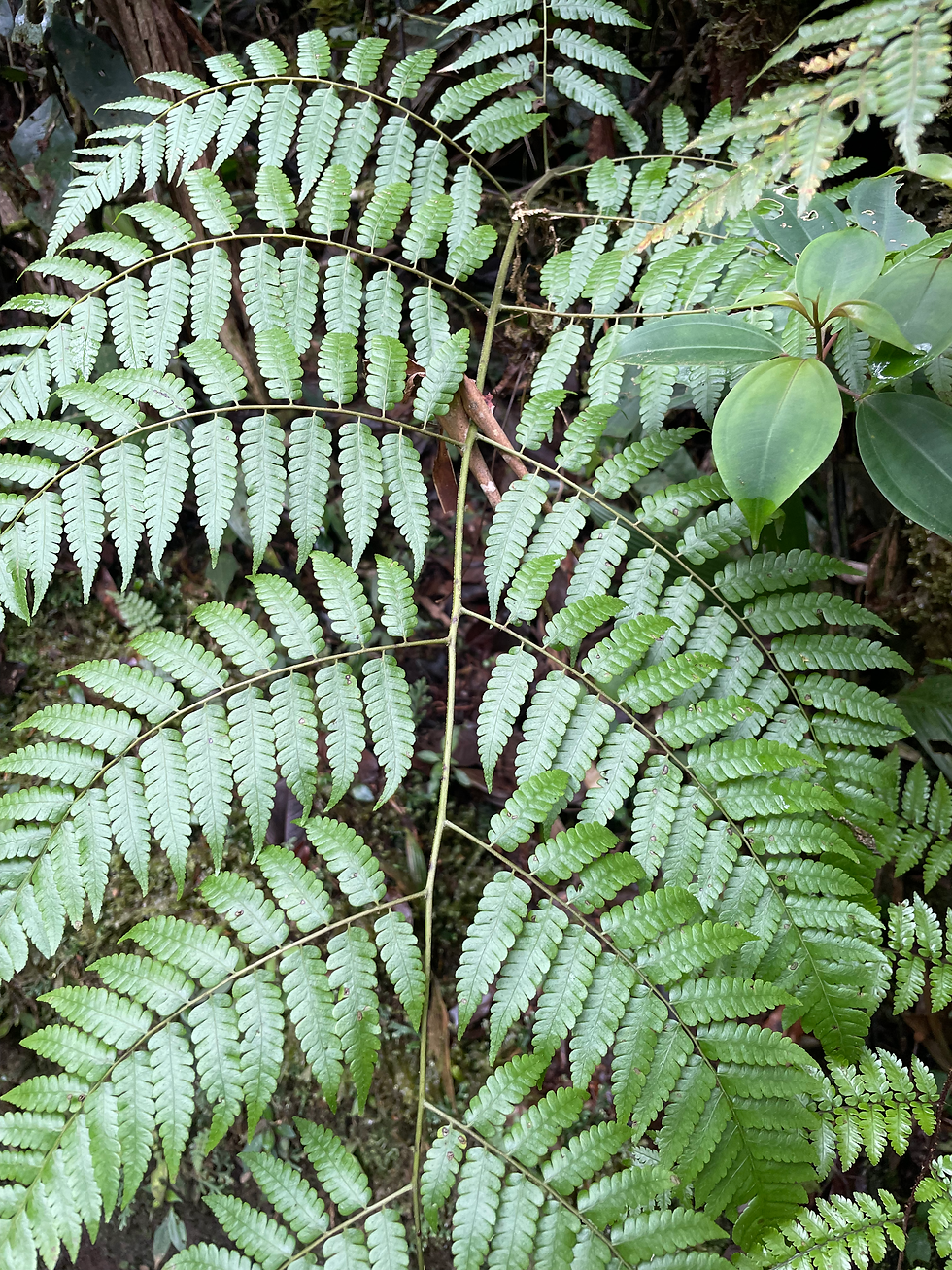
This is a unique nature reserve in the heart of a mountainous cloud forest, a delicate ecosystem where persistent fog and constant humidity create a green, dense, soft, and lively forest. The trees are covered in moss and ferns, orchids and epiphytic plants (living on other plants without harming them) cling to every branch, and all around you can hear the sounds of birds and animals living quietly without disturbance.
The trail winds through the dense forest, between layers of green and mist that moves between the trees, creating a feeling of walking in another world. The reserve was established, among other things, to protect the quetzal, Guatemala's national bird, which is completely dependent on this habitat, although we did not get to see it.
But even without the quetzal, the experience of walking through a living, breathing forest, with cool air, humidity, and a powerful view from all sides was complete in itself. We have no doubt that this is the most beautiful reserve we have been to so far in Central America. The feeling is like walking through magic in a place where the immense respect for nature is evident. One of the sentences we encountered along the way is "Enjoy your visit, and be proud partners in preserving this ancient forest."

Every day we learn a lot about the world, the roads, the people, nature, and have special experiences that expand the way we perceive reality. The journey asks us to be flexible in the face of reality and what we encounter on the roads, to soften in some ways and harden in others. We continue to live with the dissonance between the harsh reality in Israel, our loved ones who must cope with its challenges, and the life and experiences we go through here on the distant continent.
We pray and hope for days of peace, for the end of the war, for a return to a quiet routine.

The water comes from the high humidity of the cloud forest—clouds and fog that condense on the vegetation and trees, drip to the ground, and feed springs and streams within the reserve.


As always,
So happy to hear from you all,
A small WhatsApp, songs, enlightenment, requests, suggestions for efficiency.
Everything is received with great joy by us.
With love and prayers for peace and quiet
Guy, Efrat, and the Bear


Comments